

A first-timer’s walkthrough of getting tattooed in Calgary: the free consultation, deposits, real prices, appointment day, healing and touch-ups at Legacy Tattoo.

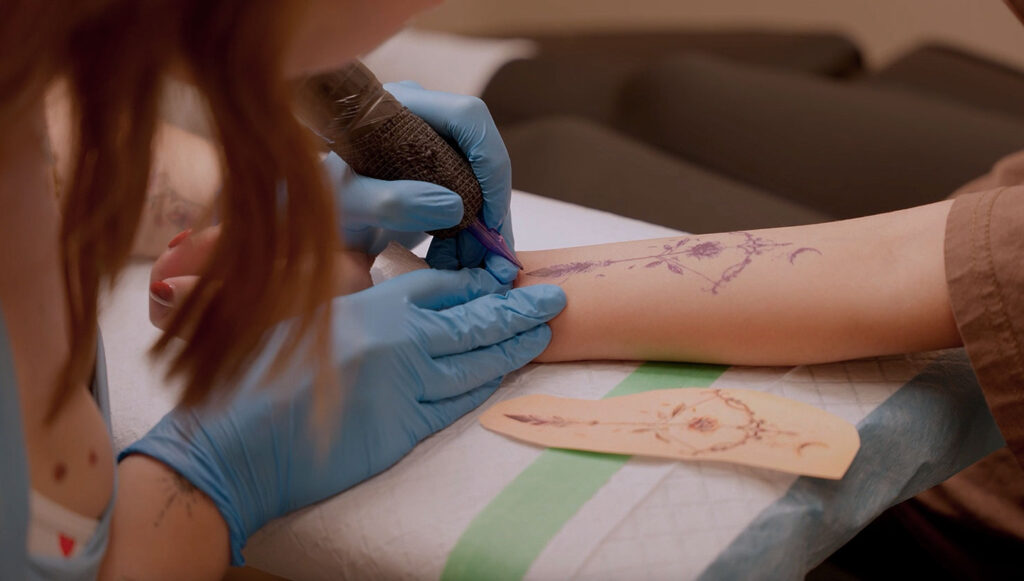
Most people getting their first tattoo ask some version of the same question in the first five minutes: should I be afraid? Afraid of the pain, of choosing the wrong design, of being judged? You shouldn’t be. But not knowing what happens next is stressful, and that’s usually what keeps someone sitting on an idea for three years instead of booking.
So here’s the whole thing. Legacy Tattoo is in Legacy Township in southeast Calgary, and we tattoo a lot of first-timers from Legacy, Walden, Silverado, Chaparral, Midnapore and the rest of the south end.
Step 1: The consultation, where the tattoo really gets designed
Your first consultation at Legacy is free, and it’s the most useful half hour of the whole process. You describe the idea, the artist tells you honestly what will work at that size and on that spot, and you leave knowing roughly what you’re spending.
Bring four things and it goes twice as well:
- Reference images. Not a tattoo to copy, but pictures showing the feeling you’re after. Two or three is plenty; upload them in our consultation form.
- A placement, even a rough one. Forearm versus ribs changes the design, the price and the pain.
- A size in real numbers. “Small” means something different to everyone. Tell us what you’re thinking in inches.
- A budget range, if you have one. Nobody’s judging it. It tells your artist whether to design a two-hour piece or a two-session piece.
Then the part first-timers skip: matching your idea to the right style. Tattooing is a set of specialties, not one skill. Black and grey realism, fineline, microrealism, illustrative work, minimalist line work, florals and pet portraits are all separate disciplines, and the hands that excel at one aren’t automatically the right hands for another. Have a look through our artists to find the style you’re drawn to, or select “Not sure” on the booking form and we’ll match you.
Step 2: The deposit, and what it’s actually for
Once you and your artist agree on the concept, a non-refundable deposit holds your appointment and pays for drawing time. It comes off your final bill, so it isn’t an extra charge.
- Valid for six months from the date you pay it.
- Rescheduling needs 48 hours’ notice. No-shows and late cancellations forfeit the deposit.
- Your first drawing is included in your appointment cost. If you come back wanting a fresh start or a changed vision, the current deposit may be forfeited and a new one required to continue.
That’s why the consultation matters. Being honest early “I don’t love the lettering” costs nothing. Changing your mind through the drafts costs money.
Step 3: What a first tattoo costs in Calgary
Straight numbers, since most studios won’t. At Legacy, hourly rates run $130 with a junior artist and $160–$200 with a senior artist, against a $150 shop minimum. For wider context, shop minimums across Calgary generally sit between CA$90 and $165, and hourly rates climb past $300 for the city’s most in-demand specialists.
Small, simple pieces are usually priced at the shop minimum rather than by the hour, and two things surprise people about that:
- A tiny tattoo isn’t proportionally cheap. Setup, sterilization, stencil and a fresh needle cost the same whether the work takes 20 minutes or two hours. Covering that is what a minimum is for.
- Fineline and microrealism aren’t faster than bolder styles. Precision is slower.
Which brings us to the easiest way to start: $99 tiny tattoos, every Tuesday and Thursday. Priced flat, quick to sit through, and one of the best first tattoos going you get the whole experience, stencil to bandage, without committing to a big piece or a big bill.
For a real number on your own idea, get in touch and you’ll get a straight quote.
Step 4: Appointment day
Four rules, and the first one doesn’t bend:
- Be sober. No exceptions. Alcohol thins your blood, which wrecks how ink sits.
- Eat a real meal first. Blood sugar, not pain, is the number one reason a first-timer feels faint.
- Arrive clean, in clothing that gives easy access to the area.
- Bring valid ID, no matter how old you look.
Nervous about pain? Numbing cream is available at extra cost and must be arranged in advance, since it needs time to work before the needle starts.
The session is calmer than the internet suggests. Your artist places a stencil and you approve the position in the mirror speak up here, because this is the moment to move it 2 cm. Then the first lines. Most people describe hot scratching rather than sharp pain, and anticipation beats reality. Ask for a break whenever you want.
Pain does vary by placement. Outer forearm, upper arm, thigh and calf are the gentlest starting points; ribs, sternum, spine, inner arm, hands and feet are the ones people remember.
Step 5: Healing, the three weeks that decide everything
Your tattoo is finished the moment you leave. Whether it stays that way is mostly on you. Our full aftercare instructions go deeper; here are the essentials.
With a second skin bandage, remove the first one after 8–24 hours depending on how much blood and plasma builds up underneath; second skin can then be worn up to five days. With a traditional bandage, leave it on 3–5 hours, or as your artist directs.
After that, the routine is boringly simple:
- Wash gently with mild unscented soap and pat dry with paper towel not a bath towel, which holds bacteria.
- Apply a thin layer of aftercare cream 1–2 times daily with clean hands. We use Ohana.
- For three weeks: no baths, no swimming, no tanning, no direct sun.
- Don’t pick, scratch or over-moisturize, and keep scented products away from it.
- Don’t exercise while the bandage is still on.
Over-moisturizing is the most common first-timer mistake. More cream doesn’t heal it faster; it suffocates the skin and can lift ink out.
Step 6: Touch-ups
Touch-ups are free within 60 days of your tattoo being finished, as long as you purchased a form of aftercare second skin bandage, Ohana, or both. They cover small spots where ink didn’t settle evenly. A touch-up isn’t a repair for aftercare gone sideways, later fading isn’t covered, and fingers, hands, feet, lips, ears and face tattoos are excluded those areas don’t hold ink reliably on anyone.
First tattoo Q&A
How old do you have to be to get a tattoo in Calgary?
Alberta has no provincial law setting a minimum tattoo age, so it comes down to studio policy. At Legacy you must be 18 with valid ID. Clients under 18 need written parental consent and must be at least 16 years of age.
How do I know a Calgary tattoo studio is legitimate?
Legitimate studios hold a City of Calgary business licence which for tattooing and piercing requires a Calgary Police Service background check and are inspected by Alberta Health Services as a personal services facility. Ask to see both. A studio that gets weird about the question has answered it.
Do I need an appointment, or can I walk in?
Both work. Walk-ins are first-come, first-served during opening hours and typically suit smaller designs or a piece from an artist’s flash. For anything like a half sleeve or chest piece, contact us in advance.
How long will my first tattoo take?
Small and simple, often under an hour including setup. Palm-sized with detail, roughly two to four hours. Anything larger may be split into sessions depending on your tolerance and availability that all gets mapped out at your consultation.
Does numbing cream actually help?
It takes the edge off, but it has to be arranged before your appointment because it needs time to take effect. Ask when you book rather than on the day.
Ready when you are
If you’ve been sitting on an idea, the consultation costs you nothing but half an hour, and you’ll leave knowing the design, the price and the plan.
Book a free consultation Call 403-355-9333
Legacy Tattoo
200 Hartell Way SE #320, Calgary, AB T2X 4S9
Open Thursday–Tuesday, 12:00 PM – 8:00 PM
Still deciding who to book with? Meet the artists and find a style that feels like yours.